
2026 Magnet Toy Safety Requirements: Compliance for Toys With Magnets
A magnet can look like one of the easiest design choices in a toy.
It is small. It is cheap enough to discuss early. It can make a product feel clever very quickly: two plush hands that connect, a character that sits on a shoulder, a magnetic chess game, a STEM building part, a fidget object, a closure on a toy accessory, a hidden connector inside a soft product.
That is exactly why magnet toy safety requirements deserve more attention before sampling starts.
The commercial mistake is treating the magnet as a feature first and a compliance component later. For toys, that order is backwards. A magnet can change the age-grade conversation, the material list, the retention design, the small-parts analysis, the test route, the supplier brief, the packaging warnings, the production inspection plan, and the recall exposure. If the team discovers those issues only after samples look good, the product is already harder to fix.
This is not only a STEM-kit problem. In 2026, magnet questions are showing up across novelty toys, games, construction sets, sensory items, plush concepts, accessories, and hybrid soft/plastic products. A plush toy with hidden magnets can look safer than a magnetic game because the outside is fabric and stuffing. But if the magnet can move, detach, break through a seam, sit inside a small accessory, or become accessible after reasonable use-and-abuse, the soft product still needs a hard compliance review.
The right question is not simply "are magnets allowed in toys?" They can be used. The better question is whether the product has been designed, specified, tested, and manufactured so the magnet does not become an ingestion, choking, retention, chemical, or documentation problem.

Why 2026 magnet toy compliance deserves attention now
Magnet risk is not theoretical. The U.S. Consumer Product Safety Commission continues to publish official recalls involving magnetic toys and magnet-adjacent toy products. The pattern is very consistent: loose or separable magnets, high-powered magnets, parts that fit the small-parts cylinder, products sold through online channels, and child access that was not controlled properly.
In April 2026, CPSC announced a recall of Magnetic Stick Figure Sets sold on Walmart by BlissfulDestiny, saying the sets violated the mandatory toy standard because they contained loose magnets that posed an ingestion hazard. In March 2026, CPSC announced a recall of GLMZZ Fidget Magnet Ball Toys over high-powered magnets and ingestion risk. The same month, Kluster Magnet Chess Games were recalled, with CPSC describing loose high-powered magnets that fit within its small-parts cylinder.
The list continues. CPSC announced a February 2026 recall of Magnetic Chess Games sold on Amazon by Kaiwenshangpin, again around loose magnets and toy-standard violation. It also announced a recall of Huaker Magnetic Balls and Rods Sets, where magnetic toy building sets raised a small-ball and under-3 choking issue. In January 2026, CPSC announced a recall of Based Online Fidget Magnet Ball Toys because of loose high-powered magnets and ingestion hazard.
These examples should not be used as gossip about sellers. They are useful because they show the operational pattern. The problem is rarely that a product contains the word "magnet" on a specification sheet. The problem is that the magnet is loose, separable, small, strong, accessible, poorly controlled, or placed into a product position where children can misuse it in a way the design did not survive.
That is a design and production-control issue before it becomes a recall issue.
Magnets in toys are not only a STEM-kit problem
Many buyers still imagine magnet risk through one category: magnetic building sets or educational STEM kits. Those products do matter, but the category is much broader.
Magnets are used in toy game pieces, puzzles, construction toys, pretend-play accessories, desk/fidget products marketed near children, collectible figures, hidden closures, packaging-like play features, poseable characters, and toy accessories. They are also increasingly appearing in plush projects, which is important because plush development can make teams emotionally relaxed too early.
A plush concept may include magnets in the hands so two characters can hold each other. It may include a magnet in the paws so the toy can hug a strap or sit on a shoulder. It may include a magnetic accessory, detachable clothing, a reversible character feature, a plush/plastic hybrid insert, or a soft animal with an internal connector. These are real product ideas, and many can be commercially attractive.
But plush does not make a magnet safe by itself.
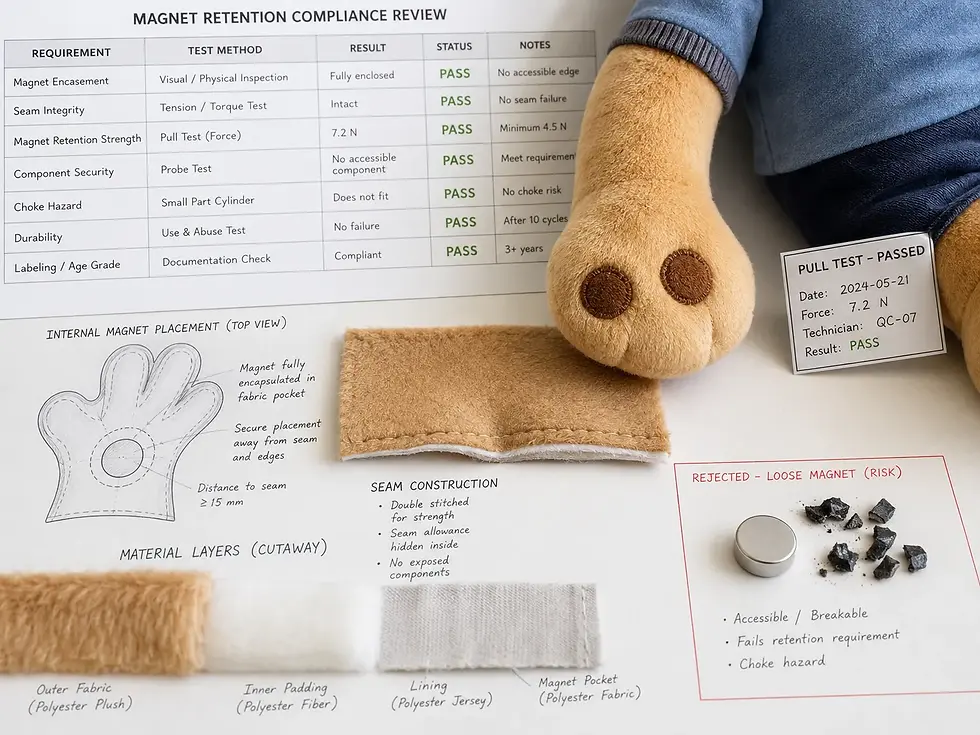
Soft construction changes the failure mode. Instead of asking only whether a plastic housing is welded well, the team has to ask whether fabric, seam allowance, thread, stuffing pressure, washing, rubbing, impact, chewing, age-appropriate use-and-abuse, and production consistency can keep the magnet inaccessible. A magnet sewn into a small fabric pocket is not the same as a magnet mechanically trapped inside a robust molded housing. A sample-room seam that holds once is not proof that 20,000 pieces will hold after real handling.
This is where a buyer needs to be practical. If the feature is essential, design it properly. If it is only a nice-to-have, consider whether the compliance and production burden is worth it. A clever magnet feature that creates a redesign, extra testing, or marketplace hold may not be clever once the landed commercial cost is visible.
The legal framework needs to be read in the right order
For the U.S. market, toy brands should start with the toy route, not with casual supplier claims. The official CPSC toy safety business guidance explains that toys intended for children 12 years of age or younger must be tested by a CPSC-accepted laboratory and certified in a Children's Product Certificate. It also points businesses to ASTM F963 as the mandatory toy standard under federal rules.
The current official U.S. toy safety text is 16 CFR Part 1250, Safety Standard for Toys. The eCFR text states the requirements for toy safety and incorporates applicable provisions of ASTM F963-23, with stated exceptions. The ASTM F963-23 product page describes the standard as covering safety requirements and test methods for toys intended for children under 14, addressing hazards that may not be readily recognized by users.
There is also 16 CFR Part 1262, Safety Standard for Magnets. That rule is important because it defines a hazardous magnet as a magnet that fits entirely within the cylinder described in 16 CFR 1501.4 and has a flux index of 50 kG^2 mm^2 or more when tested under the rule. But it must be read carefully. Part 1262 applies to subject magnet products and expressly exempts toys that are subject to 16 CFR Part 1250. That does not make toy magnets casual. It means a toy should be evaluated under the toy framework, with ASTM F963-23 and the applicable toy requirements in view, rather than treating the consumer magnet product rule as a substitute for toy compliance.
The small-parts concept still matters. 16 CFR Part 1501 describes the method for identifying toys and other articles intended for use by children under 3 that present choking, aspiration, or ingestion hazards because of small parts. The text is practical for designers because it focuses not only on the whole toy, but also on components that can be detached or broken off during normal or reasonably foreseeable use.
For the EU, the European Commission toy safety page explains that toys marketed in the EU must meet safety requirements covering general health and safety risks plus particular physical, mechanical, flammability, chemical, electrical, hygiene, and radioactivity risks. The current Toy Safety Directive 2009/48/EC still matters for market obligations, and Regulation (EU) 2025/2509 enters into force in 2026 with later application after transition. That future direction matters for product planning because documentation, digital product passport expectations, and chemical-safety discipline are becoming more important, not less.
None of this is legal advice. It is the operating map a toy team should respect before asking a supplier to make samples.
Materials matter even when the headline risk is magnetic force
A magnet specification is not only "N35" or "strong pull." Those words may be useful engineering hints, but they are not enough for a toy compliance decision.
The buyer needs to know the magnet type, size, shape, grade, coating, plating, corrosion resistance, and whether the magnet is exposed, encapsulated, inserted, overmolded, glued, sewn, mechanically trapped, or welded into another component. If the magnet sits inside a plastic housing, the housing material matters. If the magnet sits inside plush, the fabric, thread, seam construction, stuffing pressure, internal bag, and any accessory materials matter. If the magnet is painted, coated, plated, or placed near accessible decoration, chemical exposure should not be ignored.
This is especially important for children's products because accessible materials can create their own compliance questions. Paints and coatings may raise heavy-element considerations. Plasticized parts, flexible PVC accessories, printed labels, coatings, or decorative patches can raise phthalate questions where relevant. Plush fabrics, threads, labels, and fillings may need to match the intended market's chemical and mechanical expectations. EU obligations add another layer of documentation and restricted-substance thinking.
In practice, material control starts with the bill of materials. A vague line that says "magnet inside paw" is not enough. The supplier brief should identify the magnet, its dimensions, coating, retention method, surrounding material, test market, intended age grade, and inspection method. If the product includes multiple magnets, polarity and placement also need control. A wrong polarity error can turn a cute interaction into a failed function. A wrong magnet size can change retention, magnetic attraction, and compliance risk at the same time.
If the factory cannot answer the material questions before sampling, the sample is not a controlled proof. It is a visual experiment.
Magnetic force is not the same as a supplier pull-force claim
Suppliers often describe magnets in commercial language. Strong magnet. Weak magnet. N35. N52. Good pull force. Safe for toys. Those phrases can start a conversation, but they cannot end it.
The compliance question is more specific. If the magnet is loose, separable, or accessible after testing, is it small enough to fit the relevant small-parts cylinder? Does it meet the hazardous-magnet threshold under the applicable method where that rule applies? Under 16 CFR Part 1262, the hazardous-magnet definition uses both size and flux index: the magnet must fit entirely within the 16 CFR 1501.4 cylinder and have a flux index of 50 kG^2 mm^2 or more when tested under the rule. For toys, the evaluation belongs in the toy-standard route, but the same practical idea remains important: small, strong, accessible magnets create high-severity risk.
Pull force is also easy to misunderstand. A supplier may test pull force in a way that does not match the final product. A bare magnet on a metal surface is not the same as a magnet embedded behind fabric, foam, plastic, or coating. A new sample is not the same as a product after washing, rubbing, twisting, chewing, impact, or repeated attraction and separation. A magnet inside a perfect pre-production sample is not the same as magnets inserted by different operators across a long production run.
For a serious toy project, the team needs a test route, not only a number. It needs to know what will be tested, when it will be tested, which version of the sample will be tested, what standard applies, what market the test supports, and how production will be controlled so the approved construction is repeated.

Small parts, small balls, and detached components are the real design checkpoint
Small-parts analysis is not only about the toy as sold. It is about what the child can access after normal or reasonably foreseeable use. That includes parts that detach, break, loosen, or become accessible because the design did not survive the way children actually handle toys.
For magnets, that means the retained component is often the real issue. A plush paw may look large, but the magnet inside the paw may be small. A magnetic chess set may ship as a game, but the individual magnetic pieces may be the hazard. A building set may look educational, but the loose balls or rods can create choking or ingestion exposure. A magnetic accessory may be marketed as a cute add-on, but if it detaches and fits the cylinder, the risk changes.
Under-3 positioning deserves special attention. If a toy is intended for children under 3, small parts and small balls become especially sensitive. If a product is not intended for children under 3 but looks babyish, plush, sensory, simple, or preschool-adjacent, the brand should not rely on wishful age grading. Age grade must match design, marketing, packaging, instructions, reasonably foreseeable use, and the actual child audience.
This is where many online listings get into trouble. Sellers may call a product a desk toy, fidget object, game, educational item, or novelty product, but the visuals, sales channel, price point, and use case may still attract children. A warning label does not clean up a weak design if the product is still foreseeable for child use and the magnet risk remains accessible.
Retention is a production system, not a sample-room promise
Magnet retention is where good ideas become either manufacturable or fragile.
A magnet can be fully enclosed, ultrasonically welded into a housing, heat-staked, overmolded, mechanically trapped, press-fit, glued, sewn into a pocket, placed inside an inner bag, or held only by fabric and seam construction. These methods are not equal. Some may be reasonable for a given product. Some may be unacceptable depending on age grade, magnet strength, size, exposure, and foreseeable use.
Adhesive deserves caution. Glue quality can vary by batch, surface preparation, curing time, operator discipline, temperature, and material compatibility. A sample that holds because the sample-room technician was careful may not prove that mass production will hold. The same is true for sewn pockets in plush. The seam allowance, thread tension, stitch type, fabric stretch, stuffing pressure, and closing method all matter. If a magnet is inserted into a tiny fabric pocket, the seam becomes part of the safety design.
Production also has polarity risk. If left and right magnets are inserted backwards, the toy may repel when it should attract. If one magnet is missed, the feature fails. If an operator substitutes a magnet because the approved one is out of stock, the product may change materially. If the supplier buys a different coating or grade, the test basis may no longer match production.
That is why retention must be controlled in documents and on the line. The tech pack should define magnet dimensions, coating, grade or performance spec, placement, polarity, retention method, surrounding materials, inspection steps, and rejection criteria. The approved sample should be kept as a golden sample. The production line should have checks for presence, polarity, placement, enclosure integrity, and any pull or abuse checks agreed for the product.
A magnet feature is not ready just because the factory says, "we have made this before."
What to ask the supplier before sampling
The best time to reduce magnet risk is before the sample fee is paid. At that point, the buyer can still decide whether the feature belongs in the product, whether the construction is realistic, and whether the factory understands the compliance route.
A strong supplier discussion should cover the intended market, age grade, product classification, magnet size, magnet material, magnet coating, magnetic performance data, retention method, surrounding material, use-and-abuse assumptions, small-parts exposure, whether any loose or separable magnets exist, whether any small balls are included, and what test standard the supplier believes applies. It should also cover whether the factory has recent test reports for the same construction, not merely for a different magnetic product.
For plush toys, the questions should become more physical. Where exactly is the magnet located? Is it inside an inner bag, a fabric pocket, a plastic insert, or directly behind the seam? What fabric and thread are used around it? Can the magnet shift during play? Is the toy washable? Can rubbing, pulling, chewing, bending, or stuffing pressure expose the magnet? Is the magnet close to a seam? Is the magnet part of a detachable accessory? If the plush is for a younger age grade, why is the magnet feature needed at all?
For plastic toys, the team should ask whether the magnet is mechanically trapped or only glued. If it is welded, what weld process is used and how is it checked? If it is overmolded, what material surrounds it and can corrosion or movement become an issue? If it is press-fit, what tolerance controls prevent loosening? If the magnet sits in a game piece, can that piece itself become a loose high-powered magnet problem?
Those questions are not bureaucracy. They are how the buyer finds out whether the supplier is treating the magnet as a controlled component or a convenient part.

What to lock before tooling or mass production
Magnet decisions should not drift into tooling by accident. If the product needs a molded enclosure, cavity, weld line, snap feature, insert pocket, or overmolded part, the magnet retention method may be locked into the tooling. Fixing that later can become expensive.
This connects directly with How to Plan Toy Tooling in China Without Getting Trapped Later. Tooling is where assumptions harden. If magnet size, housing, polarity, assembly order, and retention method are still vague when tooling starts, the buyer may be paying to make the wrong risk permanent.
Before mass production, the brand should lock the final magnet specification, approved supplier for the magnet, surrounding materials, retention design, age grade, target markets, test standard, warning route if applicable, packaging/instruction language, production inspection plan, and change-control process. Replacement parts also need attention. If a product includes spare magnets, loose magnetic accessories, or detachable magnetic pieces, the project needs a much more cautious review.
The buyer should also decide what will happen if the factory changes a magnet supplier. The answer should not be "tell us later." Any change in magnet size, grade, coating, supplier, retention method, housing material, fabric, seam construction, adhesive, welding process, or assembly order can affect safety and test validity.
Good factories can work with these controls. Weak suppliers may resist them because they expose the assumptions. That is useful information.
How to avoid false comfort from "the factory says it passed"
A passing report can be useful, but only if it matches the product, market, age grade, construction, and production version. Many buyers accept compliance documents too quickly because they want the project to move.
The first question is identity. Is the test report for the same product, same construction, same magnet, same material, same age grade, same target market, and same standard version? A report for another magnetic item from the same factory may not prove much. A report for an earlier sample may not cover a later construction change. A report that excludes the magnetic component does not solve the magnet issue.
The second question is timing. Was the tested sample a realistic production sample, or a special sample built more carefully than normal production? If the magnet retention depends on glue, sewing, welding, or operator placement, production consistency matters. One clean test sample does not prove every production unit follows the same construction.
The third question is control. Does the purchase order, product specification, approved sample, QC checklist, inspection plan, and packaging file all reflect the same magnet decisions? If the documents disagree, production will usually follow the path of least resistance.
This is why What Overseas Toy Brands Should Prepare Before Asking Chinese Factories for a Quotation matters for magnet toys too. A vague RFQ invites supplier assumptions. A clear brief forces the product to become testable before price comparison begins.

A practical pre-production magnet-risk checklist
A useful magnet review does not need to start as a legal memo. It can start as an operator checklist, as long as the checklist is tied to the correct market standards and lab route.
Before sampling, confirm what the product is, who it is for, where it will be sold, whether it is a toy or child-adjacent product, and whether magnets are essential to the play value. During sampling, confirm magnet size, coating, force data, placement, retention, polarity, material compatibility, and use-and-abuse assumptions. Before tooling, confirm whether the magnet enclosure or pocket is locked into the tool or pattern. Before production, confirm the tested version, approved sample, bill of materials, supplier change-control rule, inspection method, and packaging/warning route.
For plush, add a separate retention review. A soft toy can hide risk well. Check whether the magnet can shift, whether seams can open, whether stuffing pressure changes the position, whether the product can be washed, whether the magnet is near the surface, whether a child can mouth or bite the area, and whether a detached fabric accessory could expose a small magnet.
For games and building sets, check whether any individual magnetic piece, ball, rod, or accessory creates a small-parts or small-ball problem. A product can be large as a kit and still risky as individual components.
For market planning, keep U.S. and EU assumptions separate. U.S. toy compliance, CPSC guidance, ASTM F963-23 through 16 CFR Part 1250, small-parts analysis, and CPSC recall history are one route. EU toy safety, CE documentation, chemical obligations, and the new Regulation (EU) 2025/2509 direction are another. A single supplier statement that "it is safe" does not replace either route.
This is also where Awen Hollek's adjacent work on Plush Toy Manufacturing in China connects naturally. Plush, plastic, STEM, and novelty toys all need different development details, but the discipline is the same: define the product before the factory fills in the blanks.
The real lesson
Magnets can be useful in toys. They can make a product more interactive, more satisfying, more displayable, or easier to connect. They can also turn a small feature into the most serious risk in the product.
In 2026, toy teams should not treat magnets as a casual add-on. They should treat them as controlled components. That means understanding the current toy compliance route, checking magnetic force and small-parts exposure, designing retention properly, treating plush magnet use cases seriously, reading recall examples as warning patterns, and making sure the production system can repeat the approved construction.
The safest time to solve a magnet problem is before the first supplier sample. The second safest time is before tooling. After production, the options get more expensive and less pleasant.
Need help pressure-testing a toy that uses magnets? Awen Hollek can help overseas toy brands, inventors, and distributors review magnetic components, plush-toy magnet concepts, supplier assumptions, material choices, age-grade decisions, testing routes, and China-side production details before a small design feature becomes a compliance problem.
FAQ
What are the main magnet toy safety requirements in 2026?
For the U.S. market, the starting point is the toy safety framework under 16 CFR Part 1250 and applicable ASTM F963-23 provisions, plus small-parts and other children's product rules where relevant. Magnet-specific analysis should consider whether magnets are loose, separable, accessible after use-and-abuse, small enough to create ingestion or choking risk, and strong enough to create serious internal injury exposure.
Are magnets allowed in children's toys?
Magnets can be used in children's toys, but they need to be designed, retained, tested, and documented properly for the intended age grade and market. The issue is not the word "magnet" by itself. The issue is whether the magnet can become accessible, loose, small, high-powered, or otherwise hazardous during normal or reasonably foreseeable use.
Why are small high-powered magnets dangerous in toys?
If a child swallows more than one high-powered magnet, the magnets can attract each other inside the body across tissue. CPSC warns that this can cause serious injuries and can require surgery. That is why loose or separable small magnets receive serious attention in toy recalls.
Do plush toys with magnets need special safety checks?
Yes. Plush toys with magnets need careful retention checks because fabric, seams, stuffing, washing, rubbing, chewing, and soft construction can change how the magnet is held. A magnet inside a plush paw, hand, belly, accessory, or shoulder-sitting feature still needs a clear age grade, material review, retention method, and test route.
What is the difference between toy magnet rules and the consumer magnet standard?
16 CFR Part 1262 is the U.S. consumer product safety standard for subject magnet products and defines hazardous magnets using small-parts cylinder fit and flux index. But Part 1262 exempts toys subject to 16 CFR Part 1250. Toys should be evaluated under the toy safety framework, including applicable ASTM F963-23 provisions, rather than treating the consumer magnet rule as a substitute for toy compliance.
What should a toy brand ask a supplier before using magnets?
Ask for the magnet size, type, coating, material, magnetic performance data, retention method, surrounding materials, polarity control, age grade, intended markets, applicable standard, use-and-abuse assumptions, test-report relevance, and production inspection method. For plush, also ask how seams, fabric pockets, inner bags, washing, rubbing, and stuffing pressure affect retention.
Can warning labels make a risky magnetic toy acceptable?
A warning label should not be used as a shortcut for a weak design. If the toy has accessible, loose, separable, small, or high-powered magnets that create a serious child hazard, labeling alone may not solve the compliance or recall risk. Design, retention, testing, age grading, and production control need to come first.


Comments