
Battery-Operated Toys in 2026: 62115, Battery Doors, Screws & EMC — The Practical Build Guide
- Dec 16, 2025
- 8 min read
In 2026, a battery toy won’t leave the dock unless it clears EN IEC 62115 (EU), ASTM F963/Reese’s Law (US), and EMC (EU: EN 55014-1/-2; US: FCC Part 15). The fastest path to “pass first time” is to design for these rules from day one: tool-or-two-action battery doors with captive screws, durable bosses and latches, and motor/MCU circuits laid out for low emissions and solid immunity. What follows is the practical playbook—written for founders, buyers, designers, and product developers who need outcomes, not theory.

The $0.02 Screw That Can Sink a $200k Season
You present renders. The buyer loves them. A prototype is green-lit and a PO is hinted. Then lab day arrives and two issues kill momentum:
The battery door opens without a tool or its screw falls out after abuse testing.
The toy fails EMC with a nasty radiated spike from a brushed motor and fast PWM.
Now containers wait, storage fees rise, and a season slips. That’s not bad luck—it’s sequence. In 2026, compliance is a design problem as much as a paperwork problem. Solve it in CAD and schematics, and you glide through testing. Treat it as an afterthought and you pay twice—once in the lab and again on the calendar.
This guide shows how to build it right the first time.
The 2026 Standards Decoder (EU vs US) — What Actually Applies
European Union (EU)
Electrical toy safety: EN IEC 62115:2020 + A11:2020 is your baseline. It tightens battery security (including captive fasteners) and access control for small batteries.
Electromagnetic compatibility: Electric toys are in scope of the EMC Directive 2014/30/EU, typically tested to EN 55014-1 (emissions) and EN 55014-2 (immunity).
Wireless toys: If you add radio (e.g., Bluetooth), you enter the Radio Equipment Directive (RED). From 1 August 2025, certain radio classes also require cybersecurity essentials—relevant for connected or smart toys.
United States (US)
Toy safety: ASTM F963-23 (effective 2024) aligns with the EU on battery access and captive fasteners. It clarifies what counts as a tool and when specialty fasteners are acceptable.
Button/coin cells: Reese’s Law pulls in UL 4200A performance requirements across consumer products with coin cells. For toys, F963 provides equivalent safeguards: tool access or two independent, simultaneous movements, plus warnings and packaging rules.
EMC: Most electronic toys are unintentional radiators under FCC Part 15 and must meet radiated-emission limits. Depending on features, you’ll follow Supplier’s Declaration of Conformity or certification.
Bottom line: EU and US now converge on the big ideas—secure, child-resistant battery access and well-behaved electronics. Bake both into design, not into last-minute fixes.
Design First: What a Compliant Battery Door Looks Like
1) Tool-Required or Two-Action Access
There are two accepted paths to keep kids out of battery compartments:
Tool-required: A common household tool (e.g., screwdriver or coin) opens the door. ASTM F963 allows specialty fasteners (Torx, hex) when you supply the tool and instruct caregivers to keep it away from children.
Two-action: Two independent, simultaneous movements (press-and-slide; dual latches) defeat casual prying. This route is common on coin-cell toys.
Choose early: If the toy targets under-8s or uses coin cells, tool-secured or rigorously validated two-action doors are the safest—and the path labs and retailers expect.
Torx and hex is rarely used in toys, and most screws are the same so just don't include the screwdriver in the box as it would otherwise be used during testing and fail.
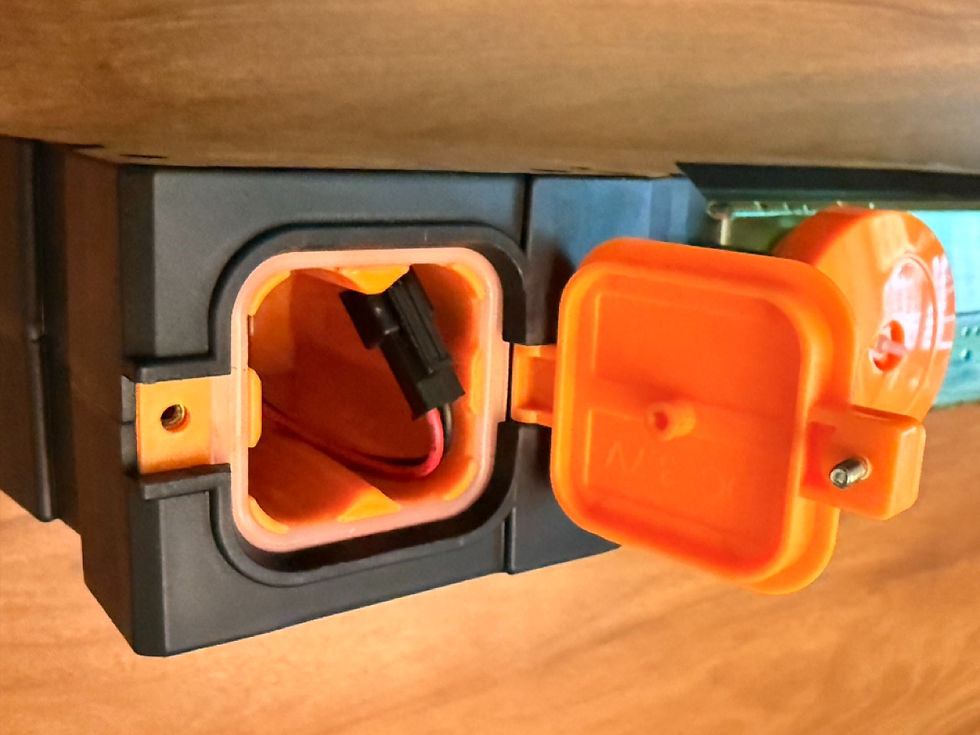
2) Captive Screws That Never “Walk Away”
Both EN 62115 and ASTM F963 require captive fasteners. In practice:
The screw stays with the door (via an under-head collar, mushroom, tether, or heat-staked retainer).
It does not fall out under pull tests or after use-and-abuse cycles.
Engineer the boss accordingly: engage ≥2 full threads, add ribs to resist creep, avoid knit lines at the boss root, and use metal inserts if the door will be opened often.
3) Survive Real Use & Abuse
Real toys drop, pry, and twist. The door must not pop open or shed parts.
Use redundancy (snap + screw).
Add anti-pry ribs and deeper latch landings.
Select tough plastics (PC/ABS or POM for hinges/latches; avoid brittle grades).
Validate with drop, pry, and torque tests on pilot parts—at ambient and hot/cold.
4) Clear Polarity & Wrong-Insertion Prevention
Key the sled so cells only fit one way, emboss polarity marks, and add reverse-polarity protection on the PCB when feasible.
5) Avoid Parallel Packs
Parallel cells create imbalance risks. Favor series for voltage; gain capacity through chemistry—not parallel consumer cells.
Coin & Button Cells: Design to Reese’s Law / UL 4200A
Coin cells have the highest ingestion risk, so expectations are strict:
Access: Require a tool or two independent, simultaneous movements. Magnets, friction, or “strong snaps” are not enough. Validate against the relevant abuse tests.
Warnings & packaging: Expect prominent battery warnings on product/packaging and child-resistant retail packs for spare cells.
Age grading: If your industrial design puts micro-cells in highly accessible areas, either over-engineer the door or move the age grade up with a documented rationale in your risk assessment.
Tip: The simplest compliant choice is a screw-secured door with a captive screw—fast for parents, robust for labs.
Screws, Threads & Plastics — The Quiet Engineering That Passes
Fastener type: Pan or truss heads spread load and feel familiar. Torx/hex reduce cam-out and give precise torque control; if you supply the tool (US), say so in the IFU.
Boss design: Dimension for thread engagement and cycle life. Add generous root fillets and ribs; keep gates/knit lines away from high-stress areas. For frequent service, use inserts.
Captive strategies: Under-head collars; swaged posts; molded tethers; or heat-stake retainers.
Material picks: PC/ABS or POM for latch/hinge elements; ABS for cover bodies. Avoid brittle grades and over-glossed textures at stress points.
Prototype like a lab:
Torque-to-fail trials on pilot parts
25–50 open/close cycles at ambient and hot/cold
Corner drops onto the door
Standardized pry/pull challenges to prove casual access isn’t possible
Outcome: A door that feels premium to caregivers and looks bulletproof to test engineers.
Bonus: EMC By Design (Not By Last-Minute Copper Tape)
What you must meet:
EU: EN 55014-1 emissions and EN 55014-2 immunity under the EMC Directive.
US: FCC Part 15 radiated (and conducted, if applicable) limits with SDoC/certification as required.
The Usual Emission Culprits in Toys
Brushed DC motors — broadband noise from commutation
PWM LED drivers — fast edges with harmonic content
MCU clocks / DC-DC converters — distinct spectral lines and harmonics
Practical Suppression & Layout
Motors: Fit three ceramics (terminal-to-terminal and each terminal-to-case), consider an RC snubber, clamp leads with a ferrite, and twist supply pairs to shrink loop area.
PCB: Decouple every IC pin, use a continuous ground plane, keep high-di/dt loops tight, and avoid unnecessary clock speeds. Where possible, soften edges.
Cables & speakers: Treat long leads as antennas; add ferrites or beads.
Plastic enclosures: If noise persists, add internal shielding (conductive coating or foil). Better yet, lower emissions at the source.
Immunity & Resilience
Add ESD protection at user-touch points.
Implement robust brown-out/reset handling so the toy recovers gracefully after a zap or nearby RF.
Wireless toys: If radio is present, plan RED radio testing and, for in-scope classes from 1 Aug 2025, cybersecurity essentials (network protection, data protection, anti-fraud).
Pre-Compliance & “Lab Day”
Book a pre-scan on an early working prototype to catch peaks. Bring a “fix kit” (ferrites, snubbers, copper tape), and log every tweak with photos so your final report is traceable and repeatable.
Result: EMC becomes a checklist item, not a delay.

The Approval Flow (EU & US) — Step by Step
Concept checkpoint
Decide battery format (AA/AAA vs coin), age grade, and whether the toy is wireless. These choices define your compliance path.
DFM pass
Lock battery door geometry (tool or two-action), captive screw strategy, boss sizing, and plastics for latches/hinges.
Safety sample review
Run internal abuse trials mirroring EN 62115 / ASTM F963. If anything looks marginal, fix it now—before tooling freezes.
EMC pre-scan
Measure emissions with motors at worst case; apply ESD to controls; harden as needed.
Formal testing
EU: EN IEC 62115 + EN 55014-1/-2 (+ EN 71 series as relevant).
US: ASTM F963 + FCC Part 15 (+ Reese’s-Law-aligned coin-cell safeguards where applicable).
Documentation pack
EU: CE Declaration of Conformity and Technical File referencing the current harmonized standards.
US: GCC for F963; FCC SDoC/cert; tracking labels; warnings; any coin-cell packaging/warnings.
Production control
Golden sample; incoming battery specs; line torque SOPs for door screws; periodic spot abuse tests; renewal calendars if retailers require periodic re-tests.
Mini Teardowns: What Fails vs What Passes
Case A — Snap-Only Coin-Cell Door (Fail)
Symptom: Door pops in a drop test; easy to pry with a fingernail.
Fix: Switch to tool-secured or true two-action access; add anti-pry ribs; widen latch landings. Validate against the relevant accessibility and abuse tests.
Case B — RC Toy Emissions Spike (Fail)
Symptom: Radiated peaks (e.g., 120–200 MHz) fail at 3 m.
Fix: Fit three caps on the motor (tune 10–100 nF), twist supply/sense leads, add a ferrite clamp, soften PWM edges. If margins remain tight, add a small local shield patch near the board.
Case C — AA Sled + Captive Screw (Pass)
Features: Deep snap plus captive screw, keyed polarity, PC/ABS latch, ribbed boss with metal insert, embossed icons.
Result: Survives drop/abuse; no loose hardware; caregiver-friendly feel.
Costs, Lead Times & What to Budget in 2026
Budget guidance (ranges vary by lab/scope):
Safety (EU/US electrical toy scope): mid-four figures per SKU when bundled.
EMC pre-scan: modest—and often the best money you spend.
Full EMC (EU + US): mid-four to low-five figures depending on iterations.
Timelines:
Lab booking: 1–3 weeks.
Safety + EMC round: 2-3 weeks per loop (longer if corrective actions are required).
Retailer onboarding (if required): driven by document review cadence.
Design deltas that save weeks: captive screws, sturdier bosses/inserts, motor caps + ferrites, twisted pairs. These changes cost pennies per unit and prevent container-scale delays.
Common Pitfalls & Fast Fixes
Snap-only doors on coin cells → switch to tool or two-action + captive screw.
Tiny screws + shallow bosses → upsize head, deepen engagement, add ribs or inserts.
No motor suppression → add 3 caps + ferrite + twisted leads; tune PWM edges.
EMC left to the end → always pre-scan; design with ground planes and decoupling from the start.
Weak/missing coin-cell warnings → adopt current warnings and child-resistant packaging.
Out-of-date references on your DoC → verify current EU harmonized lists and FCC/ASTM references before you sign.
Conclusion: Design for Compliance, Not for Luck
In 2026, the quickest route to market is simple to state and essential to execute:
Secure access: Tool-required or two-action doors with captive screws and robust bosses/latches (EU: EN IEC 62115; US: ASTM F963 / Reese’s Law for coin cells).
Quiet electronics: Motor suppression, clean PCB layout, and a pre-scan so EMC is a pass, not a postponement (EU: EN 55014-1/-2; US: FCC Part 15).
If wireless: Plan early for RED radio and, where applicable, cybersecurity essentials from 1 Aug 2025.
Do these three things early and you replace frantic re-tooling with predictable launches.
How Awen Hollek Helps You Build Battery Toys That Pass (EU + US)
Battery toys don’t fail because teams “forgot compliance.” They fail because battery access, fastening, and EMC were left to the end—when changing geometry or electronics costs weeks.
Awen Hollek helps you avoid the rework loop and ship with confidence:
Battery door + captive screw DFM review: We pressure-test your CAD for tool/two-action access, captive fasteners, boss design, latch durability, and abuse-test readiness.
Electronics & EMC pre-check: Motor suppression strategy, wiring layout, PCB grounding/decoupling, ESD protection, and a practical pre-compliance plan before you book the chamber.
EU/US test planning: Clear, retailer-ready test map (EN IEC 62115 + EN 55014 + FCC Part 15 + ASTM F963, and UL 4200A/Reese’s Law where coin cells apply).
Supplier coordination in China: Align factories on torque specs, captive screw implementation, line SOPs, and golden sample control—so production matches what passed in the lab.
Pilot + QC setup: Functional checks (battery door integrity, screw retention, polarity), and process controls that prevent “passed once, failed later.”
FAQ
Do toys with AA/AAA batteries need tool-secured doors?
If accessible to children, yes. Use a tool-required door or a robust two-action latch with a captive screw.
What triggers EMC testing for toys?
Any electronic circuitry—motors, MCUs, LED drivers—triggers emissions testing and basic immunity checks. Wireless features add radio compliance.
Are coin batteries allowed in toys?
Yes, but you must meet Reese’s Law/UL 4200A (US) and EN 62115-aligned safeguards (EU): tool or two-action access, warnings, and compliant packaging.
How do I reduce EMC risk with motors?
Add three suppression capacitors, clamp with a ferrite, twist power leads, soften PWM edges, and confirm in a pre-scan.
What documents do I need to ship?
EU: CE DoC + technical file referencing current harmonized standards.
US: GCC for ASTM F963, FCC SDoC/cert, tracking labels, and any battery warnings/packaging.


Comments