
EU Toy Safety Regulation: What Overseas Toy Brands Should Prepare Before It Bites
- Jun 10
- 9 min read
The EU Toy Safety Regulation sounds distant until you map it against an actual toy development calendar.
A team approves a concept. A supplier quotes from a loose brief. Materials get swapped during sampling. Packaging artwork starts before warnings are fully locked. The technical file becomes a folder of half-matching PDFs. A distributor asks late questions about importer details, warnings, or traceability. Then everyone tells themselves there is still time because the regulation does not apply until later.
That is the lazy reading. The practical reading is harsher. By the time the rule starts biting in the market, the brands that treated it as a future legal topic will already be paying for it in rework, document clean-up, packaging revisions, supplier friction, and launch delays.
That is why the useful question is not simply when Regulation (EU) 2025/2509 starts applying. The better question is what overseas toy brands should lock down now so the later transition does not expose weak product files, weak supplier instructions, or weak importer control.
The strongest place to start is upstream. If the product brief is vague, the compliance file will usually be vague later too. That is the same logic behind What Overseas Toy Brands Should Prepare Before Asking Chinese Factories for a Quotation. The regulation does not rescue a weak sourcing process. It punishes it more clearly.

Why this matters before the application date
The European Commission toy safety page now frames the new regime as the EU Toy Safety Regulation and says Regulation (EU) 2025/2509 enters into force on 1 January 2026 and starts applying on 1 August 2030 after the transition period. Many readers stop there and treat 2030 as the real date.
Operationally, that is too comfortable. Four and a half years disappears quickly in toy development. A product launched in the next cycle may still be in the market when the regulation applies. Packaging systems, warning structures, test assumptions, economic-operator details, technical-file discipline, and supplier documentation habits do not become reliable overnight because someone sets a later deadline in a slide deck.
The official regulation text, Regulation (EU) 2025/2509, matters because it shifts the conversation away from a broad directive mindset and toward a stronger regulation-and-enforcement mindset. The commercial meaning is simple: if your product data, warnings, conformity evidence, and responsible-party details are messy, the market will be less forgiving.
This is also why the Commission proposal COM(2023) 462 final still matters as a planning source. It explains why the reform focuses so heavily on unsafe toys remaining in the market and why the digital product passport and better enforcement logic are central. Brands should read that as a warning about process discipline, not as a theoretical policy essay.
The regulation is not only a digital product passport story
The digital product passport will get most of the headlines because it is visible, modern, and easy to summarize. But treating the whole project as a passport problem is a mistake. The passport is only useful if the underlying information is correct, current, and tied to the real product version being sold.
That means the real work starts earlier. What is the approved bill of materials? Which warnings apply to which market version? Which factory documents support the final product rather than the first sample? Which importer or economic-operator details belong on the pack? Which lab route matches the actual material and age-grade decisions? Which packaging files align with the tested product version instead of last month's draft?
If those basics are weak, the passport becomes a neat wrapper around confused data. That is why overseas brands should avoid assigning this project only to compliance admin or only to packaging. The work crosses product development, sourcing, testing, artwork approval, importer setup, and file control.
The older framework under Directive 2009/48/EC is still useful as a baseline because many teams built their habits around that world. But the new regime raises the cost of continuing with half-disciplined habits. The change is not only legal wording. It is the expectation that toy information, warnings, and supporting evidence should be more coherent and more enforceable.
Supplier briefs need more compliance detail before sampling
A surprising amount of later EU pain starts at RFQ stage. The buyer asks for a toy quote with rough materials, a loose age grade, incomplete warning assumptions, and no serious view on documentation needs. The supplier prices the product around those loose assumptions because that is the only way to move the conversation forward. Months later, the brand wants stronger evidence, different materials, clearer chemical restrictions, revised warnings, or different economic-operator details. Everyone acts surprised that the file no longer fits the product cheaply.
That is not a lab problem. It is a briefing problem.
For EU-bound toys, the supplier brief should already identify the intended markets, target age grade, likely material sensitivities, accessory risks, warning logic, packaging languages, traceability expectations, and the documentation discipline expected from the factory. If the product may face higher scrutiny around chemicals, coatings, soft-plastic parts, fragrances, batteries, cords, magnets, small parts, or online-sale presentation, those assumptions should not wait until final testing.
This connects directly to How to Reduce Compliance Risk Before Developing a Toy in China. Compliance failures often look like end-stage problems, but many of them are simply early-stage ambiguity becoming expensive. The new EU regulation increases the penalty for that ambiguity because documentation and market information need to line up more cleanly.
Warnings, artwork, and importer details should be treated as control points
Many teams still treat warnings and packaging as finish-line work. The toy is nearly done. The artwork team receives the latest text. Someone pastes in the importer details. A compliance note is forwarded from email. The carton marks are updated quickly. That workflow is exactly where later EU friction grows.
Warnings are not decorative legal wallpaper. They sit inside the market claim the product is making about age, use, risk, and suitability. Economic-operator details are not a footer issue. They are part of whether the product can be clearly tied back to the responsible business. Packaging language is not a translation chore. It is part of whether the physical product, instructions, and market obligations still match each other.
That is why buyers should force a packaging-control gate before print approval. If the toy, instructions, importer details, warning logic, and documentation structure are still moving, the artwork is not stable enough to approve. A late packaging fix is still cheaper than a finished production run with the wrong data printed across it.
The same discipline matters for online listings. The regulation text and the surrounding enforcement direction make it clear that online sale visibility and economic-operator clarity are part of the real compliance picture, not an optional channel detail. If the brand sells into the EU through multiple marketplaces or distributors, the information shown online should be treated as part of the compliance system rather than as detached marketing copy.
Technical files need version control, not a folder full of good intentions
A technical file often looks complete right up until someone actually has to rely on it. There is a declaration draft from one revision, a test report from another sample, packaging artwork from an older version, supplier material sheets without stable naming, and a bill of materials that no longer matches the approved production build.
That kind of file can survive for a while under a forgiving workflow. It becomes much riskier under a regulation that expects better traceability and stronger information discipline.
Brands should assume that every meaningful toy change needs a file-control consequence. If a material changes, what supporting evidence changes with it? If the age grade shifts, what warnings, instructions, or test assumptions move too? If accessories are added, what changes in mechanical and chemical review? If the supplier substitutes a component during pre-production, does the technical file show that reality or still describe the earlier plan?
The practical rule is simple: one approved product version should point to one coherent set of supporting records. If the business cannot say which documents belong to the actual shipped version, the file is not ready no matter how many PDFs it contains.
China-side production control will decide whether the paperwork stays true
Awen Hollek's commercial advantage is not pretending the regulation is only a European desk exercise. The real risk sits in the handoff between the overseas brand and the China-side supply chain.
A supplier can understand the headline requirement and still miss the operational one. Material substitutions happen. Colorants change. Packaging vendors work from stale files. Accessory dimensions drift. Cartons are marked from an old template. The product sample used for testing is cleaner than the one built in production. None of those failures needs bad intent. They need only weak control.
That is why EU preparation should include production-facing checks before mass output, not only document collection after the fact. Review the current bill of materials. Tie the approved sample to the intended production version. Lock the warning and artwork files before print release. Confirm which supplier records are mandatory. Make sure the factory knows which changes require approval rather than silent substitution.
This is also where Toy Pre-Shipment Inspection in China: What to Check Before the Goods Leave becomes relevant. A pre-shipment inspection does not replace proper EU preparation, but it can still expose whether the final goods, labels, packaging, and documents drifted away from the approved version. If those checks are not tied back to the compliance file, the business can still ship a neat-looking problem.
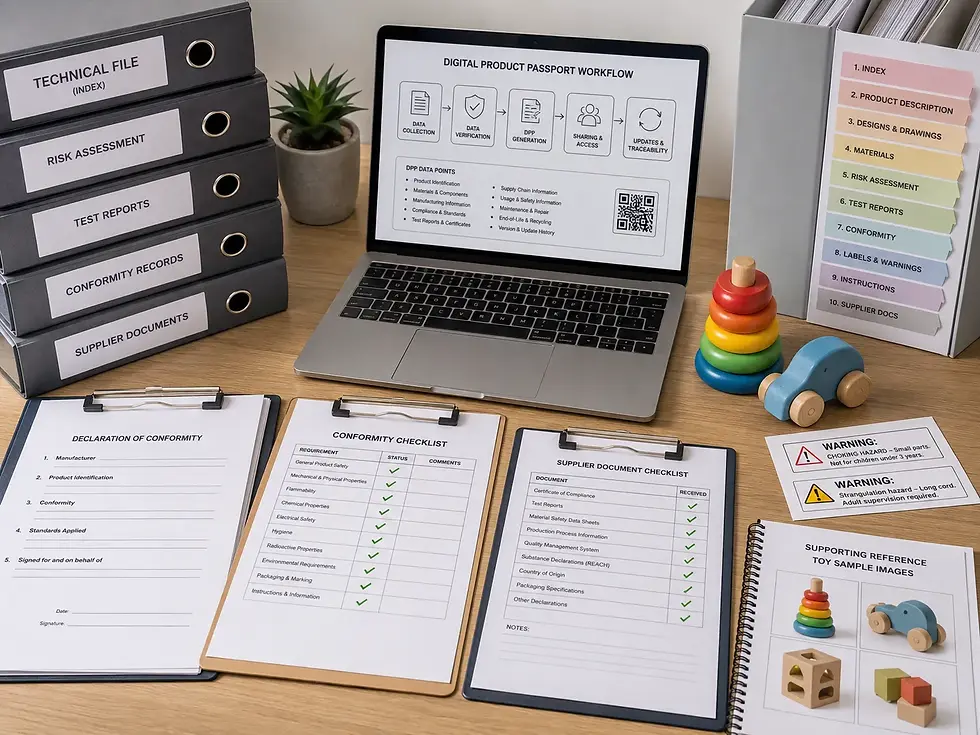
What brands should do in the next 90 days
The best response is not to launch a giant internal policy project. It is to clean up the product-development controls that will later feed the regulation.
Start with one live EU-bound product or one new product that is likely to stay in the market long enough to matter. Map the actual document chain. Which product version is current? Which warnings are approved? Which supplier materials are controlled? Which importer details are final? Which test assumptions are still current? Which packaging files are truly production-ready? Which records would you want attached to a passport entry if someone asked today?
Then pressure-test the supplier brief. Does it already state the market version, age grade, warning route, key material sensitivities, and documentation expectations clearly enough that the factory is building toward the right evidence? Or is the factory still filling in your assumptions for you?
Next, review the artwork gate. If the print file can still move without a structured sign-off on warnings, importer details, and traceability elements, the process is too loose.
Finally, decide who owns version truth. Not who owns testing, or packaging, or the declaration, but who owns the answer to a sharper question: does this exact toy version, with this exact packaging and these exact documents, still match what we intend to place on the EU market?
Why waiting gets expensive
The dangerous phrase here is "we still have time." It sounds cautious. In practice it often means the brand is hoping future admin work will solve current process weakness.
It will not.
The EU Toy Safety Regulation is a forcing function. It pushes brands to close the gap between what they think the product is and what their files, warnings, suppliers, and online presentation can actually prove. That is uncomfortable for businesses that grew with flexible development habits. But it is still cheaper to fix the discipline now than to rebuild it around delayed launches, reprinted packaging, supplier arguments, or marketplace friction later.
The brands that cope best will not necessarily be the ones with the biggest legal department. They will be the ones that turn compliance expectations into practical controls early: better briefs, tighter version control, cleaner artwork gates, clearer importer data, and stronger China-side execution.
Need help turning the Awen Hollek EU Toy Safety Regulation preparation process into workable supplier briefs, technical-file structure, packaging checkpoints, and China-side production controls before the transition becomes expensive? Awen Hollek helps overseas toy brands build the boring control systems that keep future compliance work from becoming a launch problem.

FAQ
When does the EU Toy Safety Regulation start applying?
The European Commission says Regulation (EU) 2025/2509 enters into force on 1 January 2026 and starts applying on 1 August 2030 after the transition period. Brands should still prepare earlier because product files, supplier instructions, and packaging systems need runway.
What is the digital product passport for toys?
It is part of the new EU toy-safety framework and is meant to carry compliance and related product information through a data carrier. In practical terms, it only works well if the underlying technical file, warnings, and product-version data are already coherent.
Does the new EU toy regulation affect non-EU brands sourcing from China?
Yes. Overseas brands, importers, and distributors selling toys into the EU still need the product, packaging, warning, documentation, and economic-operator details to line up with the market obligations. Sourcing from China does not reduce that responsibility.
What should toy importers ask factories for now to prepare for the new EU rules?
They should ask for cleaner bill-of-materials control, stable supplier records, traceability discipline, clearer warning and packaging inputs, and a documented rule for which changes require approval instead of silent substitution. The goal is to make the technical file match the real product version.
How is the new regulation different from the old Toy Safety Directive?
The practical difference is not only legal wording. The regulation strengthens the expectation that toy information, warnings, supporting evidence, and enforcement-ready records should be more coherent, more digital, and easier to verify across the market.
Which packaging and warning decisions should be locked before artwork approval?
Age grade, warning text, importer or economic-operator details, language versions, product identity, carton marks, and any traceability-linked elements should be stable before print approval. If those points are still moving, the artwork is not really ready.
Why can a toy still become a compliance problem even if the sample looked fine?
Because the production version, materials, warnings, packaging, supplier records, or technical file may drift away from the approved sample. A good-looking sample does not protect a business if the shipped product and its documentation no longer match.


Comments